Introduction
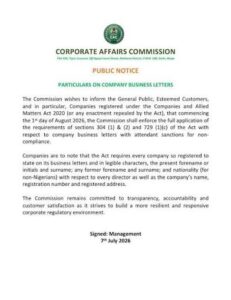
On 8 July 2026, the Corporate Affairs Commission (CAC) issued a public notice reminding companies of their statutory obligation to disclose certain corporate particulars on business letters and official correspondence. One important aspect of this is the CACs directive on company letter head. The Commission further announced that it would commence strict enforcement of these requirements from 1 August 2026 and apply the sanctions prescribed under the Companies and Allied Matters Act 2020 (CAMA) against defaulting companies.
It is important to note that the CAC did not create a new legal obligation. Rather, the directive serves as an enforcement notice aimed at ensuring compliance with existing provisions of CAMA 2020. In particular, businesses must pay attention to the CACs directive on company letter head to avoid regulatory issues.
The Legal Basis of the CACs Directive
The directive is principally founded on Section 304 of the Companies and Allied Matters Act 2020.
Section 304 requires every company to state specific information on its business letters and other official publications. It is vital to note that company heads must follow the CACs directive regarding all particulars for a compliant letter head. The purpose of the provision is to promote transparency, accountability, and ease of identification of companies and their directors by regulators, investors, creditors, customers, and the general public.
The CAC also referenced Section 729 of CAMA, which empowers the Commission to impose penalties and sanctions for violations of statutory requirements. Therefore, understanding the CACs directive on company letter head is crucial for ongoing compliance.
Particulars Required on Company Letters
Under the directive and the relevant provisions of CAMA, every company is required to ensure that its business letters and official correspondence clearly display the following information:
- The registered name of the company.
- The company’s registration number (RC Number).
- The present forename (or initials) and surname of every director of the company.
- Any former forename or surname of a director, where applicable.
- The nationality of every director who is not a Nigerian citizen.
- The company’s registered office address.
These particulars must be stated clearly and legibly on official company correspondence, as required by the new CACs letter head directive for all companies.
Documents Affected by the Directive
The requirement applies to both physical and electronic business communications, including:
- Company letterheads;
- Invoices;
- Quotations;
- Purchase orders;
- Official notices;
- Business correspondence;
- Electronic documents and PDF communications; and
- Other documents issued in the company’s name in the course of business.
Consequently, compliance is not limited to printed stationery but extends to digital templates and electronically generated correspondence. In line with this, companies must address every element of the CACs directive on company letter head to avoid sanctions.
Implications for Companies
1. Mandatory Review of Corporate Stationery
Companies must review and update their letterheads and official templates to ensure that all required particulars are included. Many businesses currently display only their company name and registration number, which may no longer be sufficient for compliance purposes. One practical compliance tip is a full checklist tailored to the company letter head directive.
2. Increased Corporate Transparency
The disclosure of directors’ names and the nationality of foreign directors will enhance transparency and make it easier for stakeholders to identify the individuals responsible for the management and affairs of a company. In turn, this transparency upholds the CACs requirements as detailed in their company letter head directive.
3. Compliance Costs and Administrative Adjustments
Companies may incur minor administrative expenses in redesigning letterheads, updating software-generated templates, and modifying electronic communication systems. However, these adjustments are necessary to ensure regulatory compliance and meet the expectations set out in the CACs company letter head directive.
4. Regulatory Enforcement and Sanctions
From 1 August 2026, the CAC has indicated its intention to actively enforce compliance with Section 304 of CAMA. Companies that fail to comply may be exposed to statutory penalties and other regulatory sanctions provided under the Act, specifically for failure to comply with the CACs directive on company letter head provisions.
5. Need for Internal Compliance Measures
Companies should immediately review their operational documents, train relevant personnel, and ensure that all departments use compliant templates for business communications. A periodic audit against the requirements of the CACs directive for all company letter head content is strongly advised.
Applicability of the Directive
The directive primarily applies to companies incorporated under CAMA, including:
- Private Companies Limited by Shares (Ltd);
- Public Limited Companies (Plc); and
- Companies Limited by Guarantee.
The notice does not expressly extend the requirements of Section 304 to Business Names, Limited Liability Partnerships (LLPs), Limited Partnerships (LPs), or Incorporated Trustees, except where separate statutory provisions impose similar disclosure obligations. Still, those falling under the directive should implement the CACs company letter head requirements without delay.
Conclusion
The CAC directive of 8 July 2026 represents a renewed commitment to enforcing existing corporate disclosure obligations under the Companies and Allied Matters Act 2020. While the requirements themselves are not new, the Commission’s decision to commence strict enforcement shows the importance of regulatory compliance and corporate transparency. Ultimately, meeting the CACs company letter head directive ensures sound business practice and peace of mind for directors.
Accordingly, all companies should conduct an immediate review of their business correspondence, letterheads, invoices, and electronic communication templates to ensure that the prescribed corporate particulars are properly displayed. Notably, ongoing adherence to the CACs directive on company letter head will ultimately safeguard companies from potential regulatory penalties.
For enquiries, you may contact us through the live chat icons on both the left and right parts of this page, or fill out the contact form here, and we’ll respond to you.
